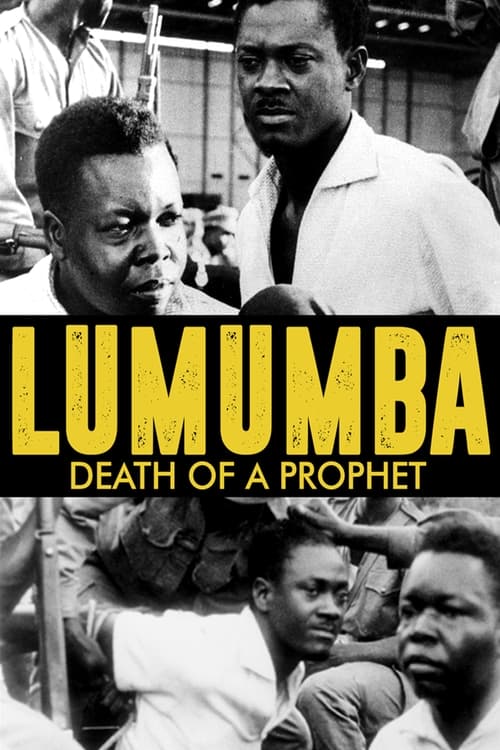
Lumumba: Death of a Prophet
Raoul Peck's Lumumba: Death of a Prophet examines the life, assassination, and contested legacy of Patrice Lumumba, the first prime minister of an independent Congo. Rather than present his history as a straightforward sequence of biographical events, the documentary asks how a political leader becomes an image, a symbol, and eventually a memory shaped by competing interests. Lumumba's brief period in power and violent removal remain central, but the film also follows the traces left behind in archives and in the societies that remember or suppress him.
Peck combines historical footage, photographs, contemporary images, and his own reflective narration to investigate the distance between recorded history and lived experience. Scenes filmed in Belgium create a striking contrast with archival material from Central Africa, directing attention toward the colonial relationships that shaped Congo's independence and its aftermath. The film's essayistic structure makes gaps in the visual record part of its subject. Instead of claiming that documentary images can settle every question, Peck exposes how images are selected, circulated, and given authority.
Made decades after Lumumba's death, the documentary is both a political inquiry and a meditation on the responsibility of remembering. Peck approaches the subject through the intertwined histories of Africa and Europe, questioning the ways colonial violence and Cold War politics have been narrated. The result is a work about more than one leader's fate: it considers who controls public memory and what is lost when an independence movement is reduced to a familiar historical icon. Peck would later return to Lumumba in a dramatic feature, making this earlier documentary an especially revealing statement of his method.
About
- Original title
- Lumumba : La Mort du prophète
- Countries
- DR Congo, France, Germany, Switzerland
- Language
- French
- Genre
- Documentary
- Running time
- 1 h 9 min
- Released
- 1991
Cast and crew

Where to watch
Not streaming yet. Tell us where it’s showing.











Comments
Loading comments…